
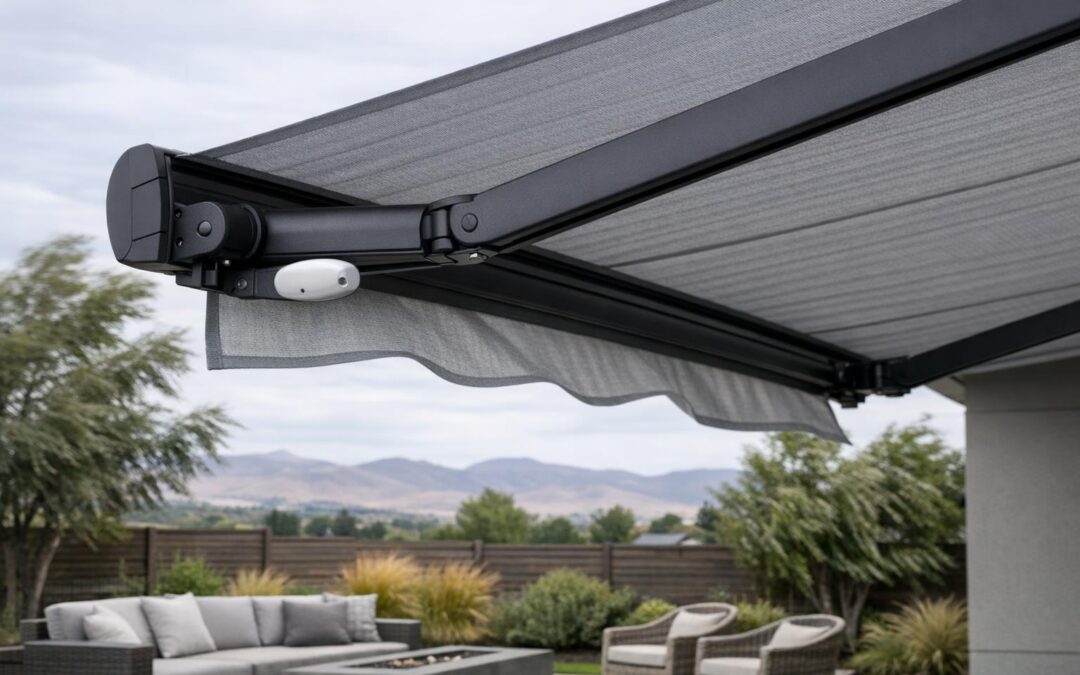
Enjoy summer shade—without babysitting the forecast
Boise summers are made for patios, decks, and backyard get-togethers—but wind can shift fast, especially around open foothill exposures and thunderstorm outflows. A retractable awning is one of the quickest comfort upgrades you can make, and a wind sensor is one of the simplest ways to protect that investment. If you already have a retractable awning (or you’re upgrading to motorized), adding a wind sensor can help prevent the most common damage scenario: getting caught open during sudden gusts.
What a wind sensor does (and why it matters)
A retractable awning is designed to provide shade when conditions are calm. Wind is different: it turns your awning into a sail. A wind sensor is an automatic safety add-on that tells a motorized awning to retract when wind becomes risky—helping reduce fabric tearing, arm damage, and mounting stress.
Key detail: wind sensors require a motorized awning to retract automatically. Manual awnings can still be protected by disciplined habits (closing early, using tie-down best practices where appropriate), but they can’t “self-save” when you’re not watching.
How wind sensors help prevent the most common awning failure
Most retractable awning problems we see from wind aren’t subtle: bent arms, stretched fabric, loosened fasteners, or a motor that’s now working harder because the frame is no longer square. The “gotcha” is that damage often happens during short gust events—not during hours of steady wind you can plan around.
| Scenario | What can happen to an awning | How a wind sensor helps |
|---|---|---|
| Quick gust front / thunderstorm outflow | Sudden uplift and arm strain; fabric flapping; mounting stress | Triggers a retract command early—before repeated loading cycles bend components |
| “Looks calm” patio, but wind channels around the house | Localized gusts slam the lead bar; awning starts bouncing | Motion sensors can retract based on movement even when the overall forecast seems mild |
| You leave home with the awning extended | No one is there to respond; wind damage can happen in minutes | Automatic protection reduces the “set it and forget it” risk |
Even with smart automation, the safest practice is to retract when storms approach. For context, the National Weather Service defines severe thunderstorms by criteria such as wind gusts at or above 58 mph—far beyond what any patio awning should be exposed to while extended. A wind sensor is a strong safety layer, not an excuse to leave shade extended in threatening conditions.
Choosing the right wind sensor setup for your Boise home
The “best” wind sensor depends on your patio layout, how exposed your lot is, and what kind of awning motor/control system you have. Here’s how to think about it in a practical, homeowner-friendly way.
Step 1: Confirm you have (or want) a motorized awning
Automatic retraction requires a motor. If your awning is currently manual, it may be possible to upgrade depending on model and condition. If you’re already motorized, the next step is compatibility: sensors must communicate with your specific motor/controller.
Step 2: Identify your wind pattern: open exposure vs. “swirl zones”
Homes with broad, open exposure (edge-of-subdivision lots, near foothill benches, or wide backyard openings) often do well with a wind-speed (anemometer) sensor set to a conservative retract threshold. Homes where wind “funnels” between structures can benefit from motion-based sensors that react to sudden movement.
Step 3: Plan the sensor location (small detail, big impact)
Sensor placement affects performance. If mounted where wind is blocked (under deep eaves, behind tall privacy walls, or in dead-air corners), it may not “see” gusts early enough. If mounted where turbulence is extreme, it may retract too often. A pro installation helps dial this in so you get protection without constant nuisance retraction.
Step 4: Decide how automated you want your outdoor comfort
Wind sensors are often part of a broader “smart shade” approach. If you’re also considering upgrades like retractable screens or a motorized louvered pergola, you can coordinate controls and usage patterns so everything works together—shade when you want it, protection when you need it.
Boise-specific tips: wind, sun, and sudden changes
In the Treasure Valley, the patio season is long—and the weather can turn quickly. If you’re using your outdoor space daily, the goal is comfort without constant manual adjustments.
Practical habits that pair well with a wind sensor
When to add a wind sensor (and when to consider a bigger upgrade)
A wind sensor is a smart add-on if you love your current retractable awning but worry about surprise gusts. If you’re doing a full backyard refresh, it may also be the right time to evaluate whether your patio needs more controllable coverage than a fabric awning alone.
Add a wind sensor if…
Consider a motorized louvered pergola if…
Get a wind-sensor-ready awning setup that fits your home
If you’re searching for retractable awning wind sensor Boise solutions, Idaho Gutter & Shade Solutions can help you choose compatible options, dial in placement, and plan an outdoor setup built for real Treasure Valley conditions—sun, gusts, and all.
FAQ: Retractable awning wind sensors
Do wind sensors work on manual retractable awnings?
Not for automatic retraction. A wind sensor needs a motor/controller to retract the awning. Manual awnings can still be protected with good habits, but they won’t self-retract.
At what wind speed should an awning retract?
It depends on the awning size, mounting height, exposure, and manufacturer guidance. Many common setups are adjusted somewhere around the 15–25 mph range for earlier protection, but your best setting should be determined by site conditions and product specs.
Are wind sensors “set it and forget it”?
They’re a major safety upgrade, but no sensor is perfect. Strong storms and severe thunderstorm gusts can exceed what patio shade products are designed to handle. Retracting early when storms approach is still the safest choice.
Will a wind sensor retract my awning too often?
It can if the threshold is set too low or the sensor is placed in turbulent airflow. Proper installation and calibration help balance comfort (keeping shade out) with protection (getting it closed before gusts ramp up).
Can I add a wind sensor to an existing motorized awning?
Often, yes—if the sensor is compatible with your motor and controls. A quick assessment can confirm wiring or wireless options and the best mounting location for reliable readings.
