
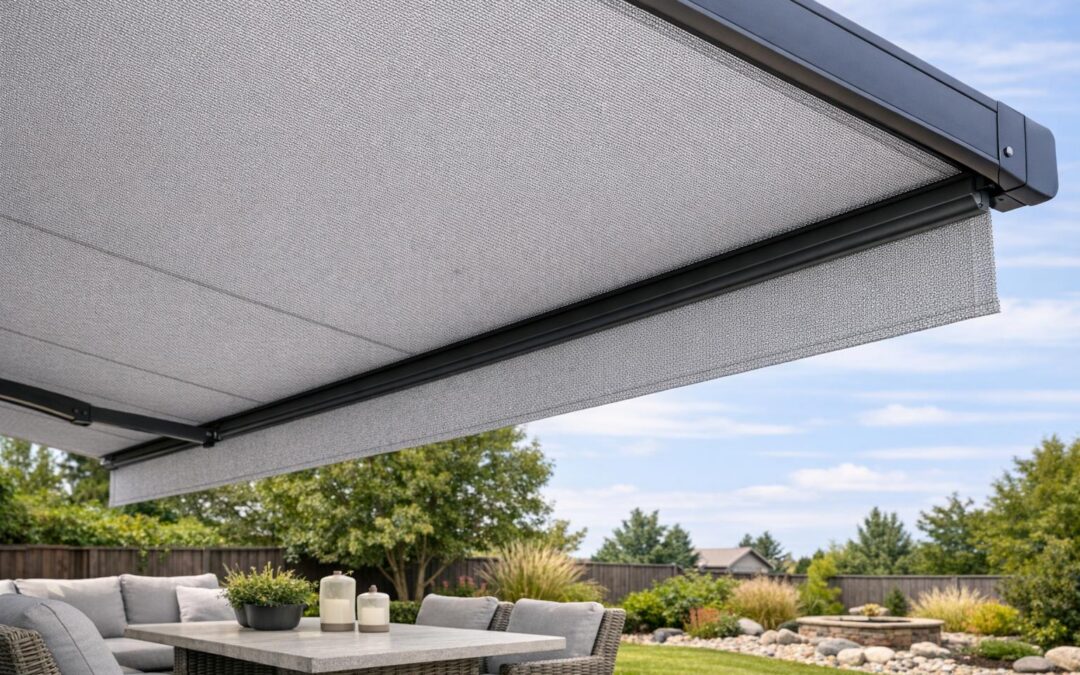
Keep your patio comfortable—without risking an expensive storm surprise
Boise summers are made for outdoor living, but our weather can flip fast. If you have a retractable or patio awning, the fabric is the first component to show age—and the most likely to fail when a gust front or thunderstorm rolls through. This guide breaks down what “normal wear” looks like, when awning fabric replacement in Boise makes more sense than patching, and which smart upgrades can help your awning retract automatically when wind spikes.
Why awning fabric fails (and why it happens faster than homeowners expect)
Awning fabric lives a tough life: UV exposure, heat cycling, airborne dust, pollen, bird droppings, and occasional surprise rain. Over time, those factors break down the fabric’s strength and protective coatings. Even high-quality fabrics typically land in a broad lifespan range, depending on material and care. Many manufacturers and fabric specialists cite typical awning fabric lifespans of roughly 5–15 years, with solution-dyed acrylic commonly lasting on the higher end when maintained properly.
Wind is the wild card. Awnings can act like sails. Straight-line winds and localized downbursts (microbursts) can arrive quickly and create intense gusts for only a few minutes—long enough to tear fabric, bend hardware, or twist arms if the awning is left extended.
5 clear signs it’s time for awning fabric replacement (not just cleaning)
1) Noticeable thinning, pinholes, or “sun splotches”
If the fabric looks unevenly bleached, feels papery, or has tiny pinholes when you hold it up to daylight, that’s often a strength-loss issue—not a surface stain. Thinning fabric is more likely to rip under tension when the awning is extended.
2) Seams pulling, stitching breaks, or edge fraying
Seams and hems take the most mechanical stress. If stitches are popping or the leading edge is fraying, the fabric may still look “fine” from the patio—but it’s already losing its ability to handle wind load and normal retraction cycles.
3) Persistent mildew that returns shortly after cleaning
Mildew can happen even with good habits, especially if the awning is rolled up damp. If you clean correctly and it comes back quickly (or the fabric smells musty when dry), replacement is often the more reliable, longer-term fix.
4) Fabric has stretched or “bags” in the middle
Sagging fabric holds water, flaps more in light wind, and strains the frame and motor (if you’re motorized). That flapping accelerates wear and can cause sudden tearing in gusts.
5) You’re babying it—because you don’t trust it anymore
If you’re retracting at the first hint of breeze because you’ve already experienced a near-miss, that’s a real signal. Good outdoor living shouldn’t feel stressful. Updated fabric plus the right wind-protection features can restore confidence.
Choosing fabric that holds up in Boise: what matters most
For many Boise homeowners, the best “value” fabric isn’t the cheapest—it’s the one that keeps its color, resists mildew, and stays stable through temperature swings. Solution-dyed acrylic is a common go-to for awnings because the pigment is part of the fiber, helping with fade resistance and long-term appearance.
| Fabric Type | Best For | Typical Longevity* | Notes for Boise Homes |
|---|---|---|---|
| Solution-dyed acrylic | Daily-use patios, strong sun exposure | Often 10–15 years with care* | Great for color retention; breathable; helps reduce mildew when properly maintained |
| Polyester (standard / piece-dyed) | Budget replacements, lighter use areas | Often 3–6 years* | More prone to faster fading and stretch; can be fine for limited sun or short-term needs |
| Vinyl-coated fabrics | Maximum water resistance, certain fixed applications | Varies widely* | Heavier feel; breathability differs; best matched to the awning style and use case |
*Longevity varies by exposure, orientation, care routine, and whether the awning is frequently left open in wind or rolled up while damp.
Wind protection that actually helps: sensors, settings, and smart habits
If your household values automation and peace of mind, wind protection is the upgrade that pays for itself by preventing the most common “one bad gust” damage. Many modern retractable awnings can integrate a wind sensor that triggers the awning to retract when wind reaches a set threshold. Some systems use motion/vibration sensing; others use an anemometer (wind-speed station). Typical auto-retract thresholds are often set in the neighborhood of 15–25 mph, depending on the model and site conditions—then adjusted for safety margin.
Step-by-step: a Boise-friendly routine to extend fabric life
Step 1: Treat the forecast like a “heads-up,” not a guarantee.
Summer storms can build fast. If you see dark vertical cloud build-up or feel a sudden temperature drop, retract sooner rather than later.
Step 2: Set your wind sensor conservatively.
Many pros recommend setting the trigger a few MPH below your awning’s rated limit to create a buffer. It’s better to retract “too often” than too late.
Step 3: Don’t roll it up wet.
If the awning gets rained on, extend it later to dry fully (when conditions are calm). This is one of the simplest mildew-prevention habits.
Step 4: Clean gently and on schedule.
Light seasonal cleaning helps prevent grime that can trap moisture. Avoid harsh brushing or aggressive chemicals unless the fabric manufacturer specifically allows it.
Step 5: Replace fabric before a tear becomes a hardware problem.
A small seam issue can become a sudden rip in a gust—then the arms, roller tube, or motor may take the hit. Early replacement is often the most cost-effective path.
A local Boise angle: where awnings take the most punishment
In Boise neighborhoods, awning performance can vary dramatically based on your home’s orientation and exposure. South- and west-facing patios often see the strongest sun load (more UV and heat), while open-lot homes or properties near foothill corridors can see sharper gusts.
If you regularly use your patio during peak summer, consider pairing fabric replacement with a wind-safety upgrade (like a sensor) and a quick inspection of mounting points and frame alignment. That combination helps your awning stay comfortable on calm days and better protected when the weather turns.
Want a quote for awning fabric replacement in Boise—or help adding wind protection?
Idaho Gutter & Shade Solutions can help you evaluate fabric condition, recommend durable replacement options, and discuss automation features that reduce wind-related damage risk—so you can use your outdoor space with less worry.
Also exploring shade upgrades? See options for retractable awnings, patio awnings, retractable screens, and motorized louvered pergolas.
FAQ: Awning Fabric Replacement & Wind Protection
How do I know if my awning needs fabric replacement or just a deep clean?
If stains lift and the fabric still feels strong and evenly thick, cleaning may be enough. If you see thinning, pinholes, seam failures, chronic mildew, or sagging/stretch, replacement is usually the safer long-term solution.
Is it worth replacing awning fabric if the frame is in good shape?
Often, yes. A strong frame with aging fabric is a common scenario. Updating fabric can restore shade comfort and appearance without needing to replace the entire system—assuming the hardware, alignment, and mounting are sound.
What wind speed should trigger an auto-retract sensor?
The best setting depends on your awning’s rating, mounting location, and exposure. Many systems are commonly configured around the mid-teens to mid-20s MPH, then fine-tuned after observing real-world behavior. A conservative setting helps protect the fabric and arms from sudden gusts.
Can I rely on a wind sensor as my only protection?
A wind sensor is a powerful backup, but it’s still smart to retract the awning when you leave home or when storms look likely. Fast, localized gusts can exceed safe limits quickly, and sensors work best as part of an overall “retract early” routine.
Does fabric choice affect indoor comfort?
Yes. Higher-quality awning fabrics can improve shade performance and reduce heat gain near patio doors and windows. Color also matters—darker fabrics often block more light but can feel warmer to the touch, while lighter fabrics can brighten the patio while still reducing glare.
Glossary (Quick Definitions)
Solution-dyed acrylic: Fabric where color pigment is added during fiber creation (not just dyed on the surface), improving fade resistance and long-term appearance.
Gust front: A fast-moving boundary of cooler air from a storm that can cause sudden wind shifts and sharp gusts.
Downburst / microburst: A localized, powerful downdraft from a thunderstorm that spreads outward when it hits the ground, producing intense straight-line wind for a short time.
Anemometer: A wind-speed measuring device (often part of a “wind station” sensor) used to trigger automatic awning retraction at a chosen wind speed.
Related services: gutter installation & repair and gutter guard systems for protecting your home’s exterior during sudden summer storms.
